COLLAPSE is Copyright 2026, William Richardson
What This Is
Collapse is a tabletop roleplaying system built around one key observation: the interesting part of being very good at something isn’t whether you succeed. It’s what succeeding costs.
It is not a heroic power fantasy, though it can handle that if that’s the kind of game you want to play. Characters are generally either competent professionals or those aspiring to be so, and their excellence is defined by who they are and what they’ve done, and by what operating at that level costs over time.
The system respects that. A trained professional performing a routine task in their field will reliably succeed. The drama is in the accumulation.
Every action costs something. A clean success costs a little. A failure costs more. A critical failure can cost a lot, if the Chorus — the other players, witnessing the fiction — decides the moment warrants it. Over hours and days, these costs accumulate across three resource tiers that model the real structure of human depletion:
The Edge is immediate energy and focus. It depletes over a working day and recovers with sleep.
The Reserve is sustained operational capacity. It erodes over weeks of imperfect outcomes and insufficient rest.
The Well is identity and purpose. It moves on campaign timescales — the slow cost of doing hard things for a long time.
The system produces campaigns with a natural arc: characters begin sharp, sustain performance through the middle act, and arrive at the endgame changed by what the work cost them. Going critical — forcing an extraordinary outcome through sheer will — is the most dramatic moment in the system, and it costs across all three tiers simultaneously. There is no free excellence.
Character creation is the sum over histories. Resolution is the eigenstate. Complexity at creation, simplicity at the table.
How the Dice Work
Collapse uses a single resolution mechanic: roll dice, add a modifier (your character’s rating minus the task’s difficulty), clamp the result to 1–100, and read the outcome from five fixed bands. No lookup tables during play. No arithmetic beyond adding one number to the roll.
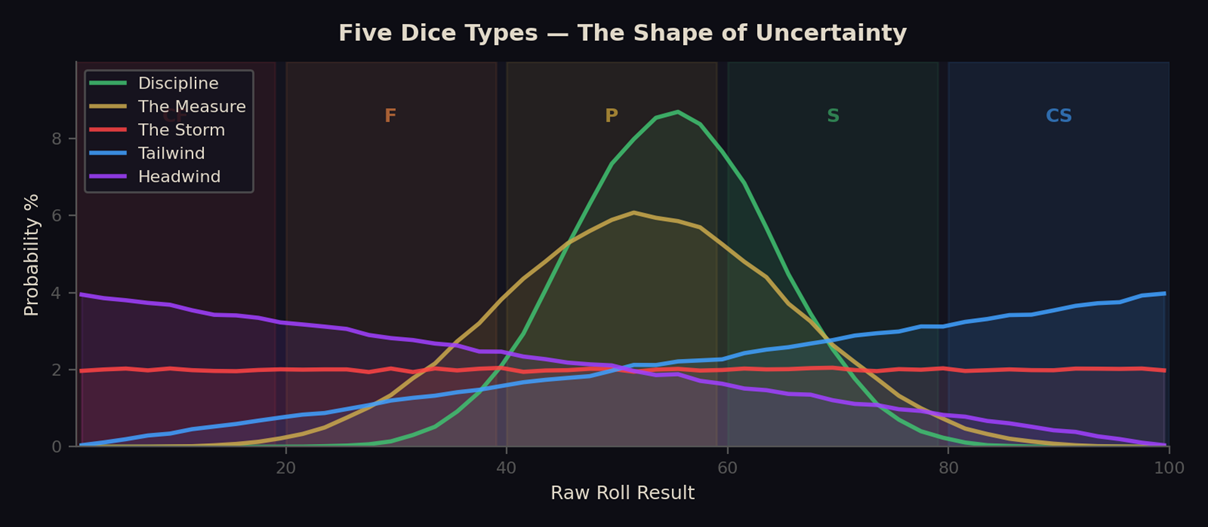
What makes the system distinctive is the dice selection. There are five dice types, and each one produces a fundamentally different shape of uncertainty. The GM’s choice of dice type is a narrative statement about the nature of the situation — not a difficulty modifier, but a declaration about how much chaos the world is imposing.
Discipline (10d10)
Ten ten-sided dice, summed. The tightest bell curve. Mean 55, standard deviation ±9. Almost all results land between 40 and 70. The character’s training is asserting itself against variance — the outcome is nearly predetermined by competence. Used when a deeply practiced skill meets controlled conditions. The marksman on a familiar range. The surgeon in a well-equipped theatre. Freak events are mathematically negligible.
The Measure (5d20)
Five twenty-sided dice, summed. The professional default. Mean 52, standard deviation ±13. A real bell curve with real tails. Competence shapes the outcome but doesn’t guarantee it. This is the working distribution of professional life, where skill matters and uncertainty is present but not dominant. A trained professional with a positive modifier will almost never see a Critical Failure on the Measure — but it’s not quite impossible, and the character knows that.
The Storm (1d100)
One hundred-sided die. Flat distribution. Every number from 1 to 100 equally likely. The world is in charge, not the character. Used for chaotic situations, untrained attempts, conditions so degraded that skill can’t impose order on the outcome. Also the correct choice for heavily asymmetric contests — because in a Storm, the novice can get lucky and the expert can have the worst moment of their career. This is where freak events live. On purpose.
Tailwind and Headwind (2d100, keep high or low)
Roll two d100, keep the better or worse result. Tailwind skews toward success — favourable conditions, the situation working for the character. Headwind skews toward failure — adverse conditions, everything working against. Both preserve the flat unpredictability of the Storm but impose a directional bias. Fortune favouring the prepared, or the universe leaning on someone already struggling.
What Competence Does to the Curve
The modifier — character rating minus task difficulty — shifts the entire distribution left or right across the outcome bands. It doesn’t change the shape. A trained professional with modifier +12 on the Measure pushes the bell curve so far right that Critical Failure falls off the edge of possibility. The same professional at modifier -12 (operating far beyond their training) pushes it so far left that Critical Success becomes essentially impossible.
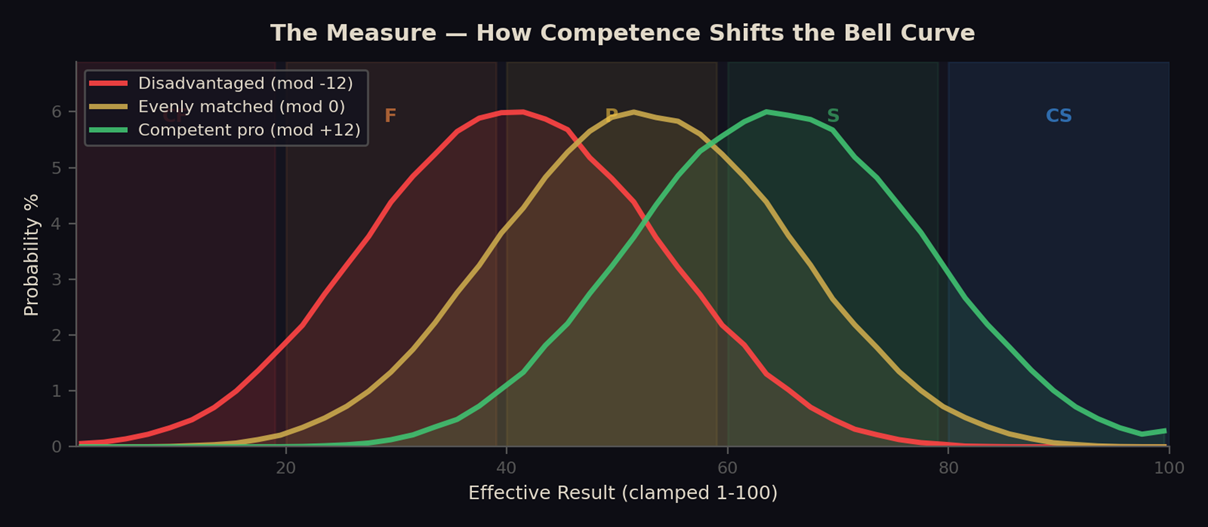
This is the core insight. The dice type controls the shape — how concentrated or dispersed the outcomes are. The modifier controls the position — where the mass sits relative to the outcome bands. A GM who selects the Measure for routine professional work is choosing a world where competence dominates. A GM who selects the Storm is choosing a world where anything can happen.
Neither is correct in the abstract. Both are correct when the fiction calls for them. The system gives the GM a vocabulary for describing the nature of uncertainty in any given moment, and the players can feel the difference at the table without understanding the mathematics.
What Different Scenarios Produce
The interaction between dice type, modifier, and the five outcome bands produces dramatically different probability landscapes depending on the situation. Here are six scenarios that span the range of play:
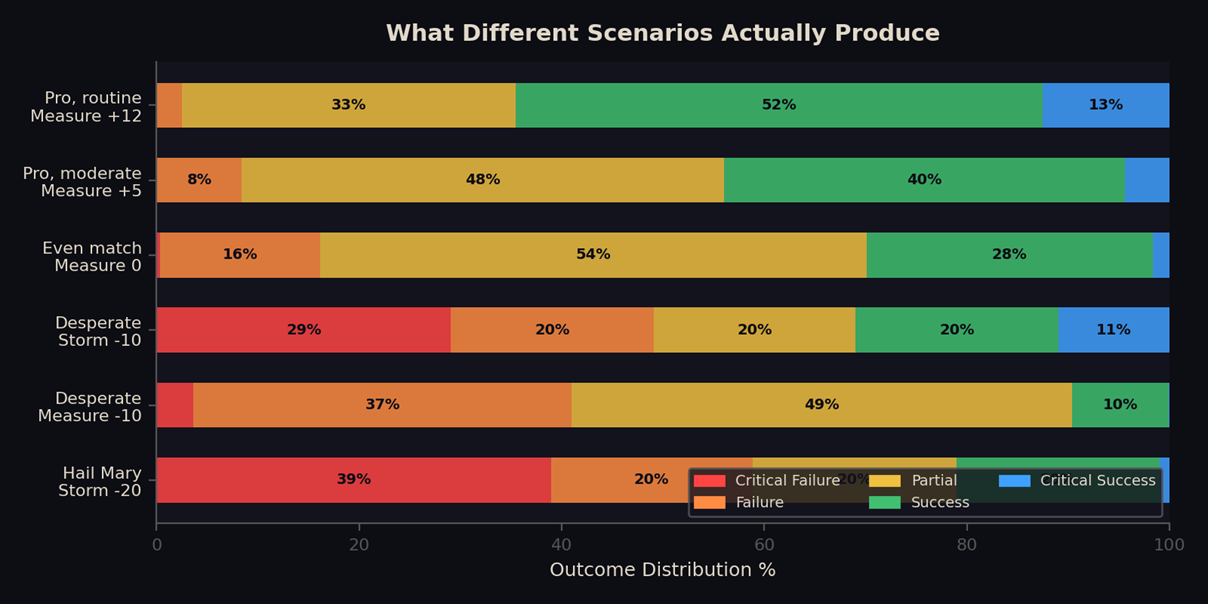
The top bar is the trained professional doing what they’re trained for. Over half the outcomes are clean Successes. Critical Successes — moments of grace, flow state, the universe aligning — appear about one in eight. Failures are rare. Critical Failures don’t appear at all. This is the mechanical expression of competence: the character isn’t rolling to see if they can do the job. They’re rolling to see what the job costs.
The bottom bar is the Hail Mary. Modifier -20 on the Storm. Nearly 40% Critical Failure. But notice the thin blue sliver at the right edge: about 1% Critical Success. One in a hundred. In a desperate moment where everything has gone wrong and the fiction says nothing should work — something can still work. Rarely. Memorably. The system preserves the upset because the Storm preserves the upset. The GM chose this dice type precisely because the situation is chaotic enough that the impossible remains possible.
The middle bars show the gradient. As modifier decreases, the distribution shifts left. Partial Success — succeed with cost or complication — becomes the most common outcome. Failures begin to dominate. The resource costs mount. The campaign arc emerges not from a single catastrophic roll but from the accumulated weight of many imperfect outcomes over time.
On Freak Events
Every tabletop system has to answer the question: how often does the impossible happen?
In Collapse, the answer is: exactly as often as the GM decides it can. The dice type is the control. On Discipline, freak events are mathematically impossible — the bell curve is too tight. On the Measure, they’re vanishingly rare at positive modifiers (zero Critical Failures in half a million simulated rolls at +12) but increasingly present as modifiers go negative. On the Storm, they’re always present — one in fourteen at +12, one in nine at -10 — because the flat distribution has no bell curve to suppress the tails.
The design principle: the GM selects the dice type, and in doing so, selects how much the world is allowed to surprise everyone. The Measure says: skill is in charge, but the world has a vote. The Storm says: the world has the floor. Discipline says: the character’s training has closed the door on chaos. Each is true in different moments. The COLLAPSE system makes the choice legible.
This means the lowest possible roll on any die can produce a freak outcome in either direction. A natural 1 on 10d10 is a 10 — Critical Failure territory even at high modifiers if you could ever roll it. A natural 100 on the Storm at modifier -20 produces an effective 80 — Critical Success, the impossible made real. The system doesn’t prevent these moments. It gives the GM precise control over how likely they are.
GOING CRITICAL
In those rare moments when the narrative demands a character succeed in the face of, or perhaps in spite of, tremendous adversity, Going Critical is a whole-person event. It forces a Critical Success regardless of what the dice show. This is not a tactical option to be optimised. It costs across all three tiers simultaneously, every time. The fiction—essentially the general quality and depth of the storytelling your campaign does—will tend to do its own work in informing when the appropriate moment is to deploy an event like this. The cost of choosing to Go Critical, choosing to collapse the waveform through deliberate intent when it matters most, is deep and usually permanent. It’s purchased through narrative weight.
In a movie this is what the main character digs deep to pull out when most of the audience is in tears.
A character who goes critical frequently will accelerate depletion across all three tiers simultaneously and reach operational incapacitation and Broken state far ahead of the campaign's natural pace. This is the game system doing what it is designed to. Going critical must feel like what it is: the moment of truth. Daniel San delivering the crane kick. Rocky Balboa throwing that decisive punch.
The game rules provide three Critical Styles. These are permanent and chosen at character creation. They reflect who the character is in relation to risk and sacrifice—how this specific person goes to that place. THE COMMITTED, THE FORGED, and THE CALCULATED.
Fidelity Is the GM’s Game
The probability engine is precise, the outcome bands are fixed, and the dice distributions are mathematically rigorous, but the inputs to that engine — difficulty, dice selection, condition modifiers, what constitutes a Q7 event — are entirely GM-driven. The system is a high-fidelity instrument played by a human of variable calibration.
Think of it as a spectrum: cartoon, comic book, movie, documentary. A cartoon GM sets difficulty for a laser-mirror interaction at Trivial because mirrors reflect lasers. A comic book GM sets it at Routine because it’s a known technique with complications. A movie GM sets it at Moderate because the angle matters and the scene needs tension. A documentary GM sets it at Hard because the wavelength is 1064nm, the surface is brushed aluminium, the diffuse feature scale is larger than the wavelength, specular reflection is partial at best, and the beam divergence over this distance means the spot size is already degraded.
All four GMs are using the system correctly. The Measure doesn’t care why the difficulty is 18 or 42. It produces an honest probability distribution against whatever number it’s given. The accuracy of the fiction scales with the GM’s domain knowledge. The accuracy of the probability is constant.
The same campaign can run at different fidelity levels for different domains. A GM who’s a combat veteran and an amateur astronomer runs infantry operations at documentary level and space navigation at movie level. The system doesn’t notice. The players might — the infantry scenes will feel more granular, more surprising in what the GM decides is hard versus easy. The space scenes will feel broader, more cinematic. Both are honest play.
The player side works the same way. A player who understands ballistics builds a character whose specialisation ratings reflect real skill development pathways. A player who doesn’t builds one that feels right at a broader level. The creation economy works either way — the component budget constrains what’s possible regardless of whether the player knows why their character has Cognitive Experience 7 or just knows it feels right for “smart and experienced.”
This is a feature. A system that required documentary-level accuracy from every GM for every domain would be unplayable. A system that prevented it would be unsatisfying for GMs who have it. Collapse accommodates both by making the probability engine domain-agnostic and the difficulty input human-driven. The GM brings what they know and the system does the rest.
Why This Matters at the Table
Most roleplaying systems use a single resolution mechanic that applies uniformly to all situations. The drama comes from whether the character succeeds. Collapse inverts this. The drama comes from the cost of operating, and the probability engine gives the GM a toolkit for matching the mathematical texture of uncertainty to the fictional texture of the moment.
A surgery scene uses Discipline — the surgeon’s training dominates, the outcome is almost certain, and the tension comes from the resource cost of sustained performance. A firefight uses the Storm — chaos dominates, anything can happen, and the tension comes from genuine outcome uncertainty plus the accelerated depletion from rapid action. A negotiation uses the Measure — skill matters, the outcome is probabilistic, and the tension comes from watching the bell curve interact with the stakes.
The players don’t need to understand any of the math. They experience it as feel. “Roll Discipline” feels different from “Roll the Storm” at the table, even without knowing the standard deviations. The names carry the information while the curves do the work.
Five dice types. One resolution mechanic. The GM selects the shape of uncertainty. The modifier selects the position. The outcome bands are fixed. The character is who they are. The dice collapse the probability space into a single moment of truth.
If you are interested, please drop me a line on the CONTACT page. The full basic ruleset is about 50 pages, and character records, reference cards, and a campaign engine (a quick HTA-based system for handling up to five characters on a PC) are available.
If you would like to play with a few of the system’s features in interactive applets, please CLICK HERE.